Monday, 27 January 2014

Expedition NW3, 2014 - Day 0 & 1


The boat that took us from Changanacherry to Kollam
Mr. Biju
Day 0 - We started the journey from Akkarakalam resort near Nedumudi, Alapuzha Dist, Kerala. The powered boat of 15m length had Mr Biju as its helm. After loading and securing the 3 kayaks we headed for Kollam at 630AM. It’s customary to stop at a place of god and pray, we did just that at the Church, opposite to Akkarakalam. 


Champakulam Chruch
Along the canal from Karumadi to Thottapally
The breakfast stop was the small Kappikada, at Champakulam, past the Church that is more than 400 years old. I had made the stop there few weeks back on my practice session from Changanacherry to Ambalapuzha. The morning breakfast at the traditional hotels(Kappikada) is just amazing. They may not look much upscale, but the food is amazing. After the breakfast, we cut the route short by taking the canal at Karumadi that connect Thottapally. The route here is beautiful; was told later that the route via Thakazhi and Edathua was even better. This canal forms part of the Alapuzha-Kollam KWTC (Kerala Water Transport Corporation) twice daily boat service, which is the recommonded mode to explore the waterways. Thottapally is the southern end of the Vembanad lake system; that forms the delta of all rivers of central Kerala. During the mansoon, water levels are high enough for the spillway at Thottapally. During summer the flow ebbs down and the spillway, prevents saline water coming into the Vembanad lake.

Traditional house near Champakulam


Pallana River


Past Kayankulam Kayal


Kayaks on top of the boat
The spiders of the waterways - Kayankulam Kayal
Going past Thotapally, we entered Pallana river that connects to Kayankulam Kayal. Dedging by IWAI(Inland waterway authority of India), was in full swing. Pallana river leads us to Thrikunnapuzha locks at the far south. The stop at KV jetty was sombre on realization that no rice boats made overnight halts at KV Jetty! The early morning Kapaikadas(local tea shops),where gone, as tough an era had ended. These Kapikadas start around 3AM and were serving breakfast at 4 to help the rice boatmen make the best of the tides. KV Jetty reminded about the 2 rice boat men – Arjun and Kasimka. We had called Kasimka to be at Kollam Jetty for the flagoff, on 12th Jan. He could not join as his son was recuperating after surgery. After tea we headed to the locks at Thrikunnpuzha that were open and led us to Kayankulam Kayal.

NTPC loomed large on our left and Mrugan recalled how his Father working for KSEB was deeply involved in the project. We were accompanied by scores of river terns in Kayankulam Kayal and Murgan explained how these birds from the Himalayas make their annual winter trip to Kerala.

Water lillies at KV Jetty, Pallana River.
Crossing the Pulkulungara jetty bridge we saw the sight that cannot be explained. For the next few kilometres on either side of NW3 stood hundreds of Chinese fishing nets. They looked like some monster spider, waiting to pounce on anything that came its way. We were surprised that this landscape was never seen by any of us, even as a picture. Reaching the far end of the Kayankulam Kayal we entered the canal that would take us to Vatta Kayal, passing through Azheekal, Vallikavu and Alamkadavu.

Reaching Alamkadavua Mr Biju advised we break for lunch, as there would be none going forward. We stopped at the Alumkadavu jetty and were reminded by locals how the new bridge that connected to Alappad road had made Alumkadavu redundant. The place looked deserted for the kind of depth it had. People shared how this gateway was connected to the mainland and folks from the seafront would take boat rides early morning to reach Alumkadavu. Roads were the biggest competition to the waterways, though the latter is the cheapest mode of transportation and remain underutilized in Kerala. We were served piping hot rice that was boiled with salt and to our amazement found that no side dish was required to munch it down. The three of us made a plan to visit the same shop, when we got going from Kollam on our trip. We reached Vatta Kayal and Mr Biju showed us the bridge from where Island Express had jumped rail, marking one of the worst rail tragedies in Kerala. Past the Vatta Kayal, we entered Chavara Thodu, a narrow canal (read most polluted), passing titanium mining from sea sand and locals competing with each other to dispose all kinds of waste into the waterways.

Coming past Chavara Thodu we entered the beautiful Ashtamudi lake as each of us took turns to master navigating the boat, which was tricky. Astamudi Kayal was huge and pricked with mangrove forest that jetted out to make the landscape look beautiful. We reached Ashramam Jetty at around 4 and found the Yatri nivas, perfectly placed for our trip next day. The entire place fouled like a puddle of faeces and we realized how true our guess was. We had to now start the journey in this polluted waters and decided to skip the photo/practice session.

Vilakamma Statue near Kollam.
Hotel Ravitz near Kollam.
Day 1 - The openign ceremony started at 9AM, with the arrival fo the Kerala Chief Secretary, Shri. Bharth Bushan. The place stinked of garbage and we had a lot of visitors covering their nose. After the flag off from Kollam Jetty at around 09:45AM and paddled past the famed Ravitz hotel & Vilakamma(Statue) heading towards the Puthiyakavu Central School. As we moved away from Kollam, the water quality improved, dramatically. It took us an hour to reach the school and we delivered the first session with help from Mr. Shafeeq, Head of SEED, Kollam, & Dr. Manoj CN of Pelican Foundation. We paddled on around 4PM for Dalavapuram going past Sambrani Jetty on the southern shores of the Ashtamudi Lake.

Anees!
Ashtamudi Lake beckoned us with the evening sun, getting ready to set and a low tide that made mud flats more of a risk. We were amazed that a lot of mud flats appear during low tide and the channels are filled with fish, may jumping in schools in front our Kayaks. The plan for a shorter route to Dalavapuram (our night camp) made us run the kayak into shallows just over 6 inches. Our effort to cut the journey short by taking a straight line to Dalavapuram ran aground. Our colleague Murugan had to get off his Kayak and push it out of one mud flat where it got stuck, forcing us to follow the red and green buoys of the NW3. He will qualify as the only person who has pushed in both land and water! The setting sun highlighted the mangrove cover in the lake by making them radiant green. There were a lot of birds to observe and document. Reaching Dalavapuram, we had a new challenge.

Murugan;  our beloved "Tipper anna"
A group of hooligans on the west side of the bridge wanted the kayak and threatened to drop stones from the Dalavapuram Bridge; it was chaos as we retreated to the backwaters for safety. We got help from the locals ward member and few elderly locals and pitched the tent right in front of the St. Joseph's Church, Thekkumbhagom, on the eastern side of Dalavapuram bridge.  We were assured that the place was safe and no one dared to bother us. The earlier experienced haunted us and we felt very unsecure at Dalavapuram. One elderly gentleman Mr Joseph, volunteered to drop in and stay with us to ensure safety. We got permission to pitch our tent between the Chruch and the jetty. Frankly, the tent was a bit too small for the 3 of us.

Mangrove forest in Ashtamudi Kayal.
That night we had to be contended with pazhampori(Fried sweet horn banana) for dinner as the neighbourhood meeting lasted till Ten, dimming our chances of finding any Kappikada (local eateries that serves hot food). Our fears returned that night as we were woken up with commotion at the church jetty, we woke up to find local fishermen who had pulled in to secure the crabs they had harvested from the Ashtamudi lake. We were surprised by the pincers these crabs had and also felt sad for few juveniles that were being taken to the market - human greed can decimate nature! When asked, the fishermen replied "If I don’t take them, some else will".  Gandhiji came into focus for his saying - Be the change you wish to see in the world.”

Tuesday, 21 January 2014

Preparatory trip;Changanacherry - Ambalapuzha - Dec 29th 2013

This last Decemeber, 29th, 2013,  Sunday,  I started paddleing from Kidangara to Ambalapuzha, around 6AM. This was planned as prep session to make myself ready for Expeidtion NW3, coming a fortnight later. As per the initial plan, I made my left at Kodupunna from the AC Canal(The AC Road came much later!), but got adivce from a household that the route was clogged with hyacinth. These weeds made their way, thanks to global trade during British times and find Kuttanad a great place, thanks to our intervention with nature! This made me padle back to the Alapuzha-Changanacheery canal and head eastward towards Nedumudi. Why would they call this the AC canal, when in reality you can only use it upto Kidangara. Thougths flashed through my mind on why the reminder was not accessible: was it covered with hyachinth? or was it reclaimed by mud bought in by one of the thousand tipper lorries that escape the NGT-National Green Tribunal? Anyway, I kept paddleing on the AC Canal and used each foot over bridge as  a target to keep my spirits high, as I compared my speed to the vehicles running along the AC Road. I did my own calculations and found that Changanacherry to Amabalapuzha was around 35Km, by road. My trip using the waterways was only 22Km, saving a13!. Then, why is that the waterways in kerala are not thought about when you see roads clogged all over the place. Why on earth have our waterwasy fell to dis-use or abuse rather. There were garbage piled high on the banks, along the AC road. The shops that were put up on pillons jutting into the canal reminded of the hotels and resorts in uttarakhand that had encroched on Alakanand & Mandakini. I saw people using the waterwasy for thir daily chores, many of them calling their kids to come and have a look at the odd yellow boat(my kayak). Reaching Nedumudi, I turnred left into small canals, heading towards Champakulam. There was a church, in front of which was a large Sunday mass. The canal here was blocked and some pilon was being built, perhaps another foot-over bridge or if  kuttanad is unlucky, another Road!. Net effect, man made obstacles and deicsion has slowly driven the nails on kuttanads coffin, as the flow of water is restricted, in small canals and the large lakes, thanks to the never ending hunger for reclaimed land, un-scientifically build bridges and structures like the taneermukkam bunds. Once upon a time, water would ebb-and-flow from 3 points - Taneer mukkam opneing, thotapally and alapuzha beach. All these points are today blocked, making the waterways the largest stagnant water body in kerala, resulting in perhpas, more harm than good. My envy for the people of kuttanad gave way to revulsion thinking of their plight, surrounded by stagnant water. Any way, I took inputs from the locals and made few truns to arrive north of Champakulam, into the main river artery, that is clean and in much better shape compared to the small canals, that criss-cross kuttanad. Being a Sunday, all shops were down and I had seen people walk to Chruch service at many places. I enquired about any place for the morning breakfast, when i was diected to the NSS Karayogam building in Champakulam. The beautiful Champakulam church loomed over the horizon. I wondered, how the place would have been a 100 years back  - Lot of rice boats bearthed in the nearby jetty, and less shops for sure on the water front. I was stuck by the Chicken shop near the jetty, that was operating in a rather strange way. The buthcer was hacking chickens(thanks to the Foot and mouth disease) and dumping the offals into the water, from his riverside stall. Fish, may be catfhis of some kind was surely having heavns open for them, with chicken parts falling for free. I felt bad at  the sight, but quickly gained my balance for the culture that packs animal offal in plastic bagas and then dumps them all over the place. Me and my firends call this "the smell of gods own country" as you find it all pervasice in the state. The 36Rs. Dosha, Kadalacurry and hot tea, was a blessing compared to the standard food you get in Bangalore or any city for that matter. I paddeled a kilometer or so south, before taking a right to join the other major river canal that would take me to Ambalapuzha. One think is clear, the big canals in Kidangara, Champakulam and Pallathruthy are so clean, perhaps they still had some flow and the water transport boats did shake up the place dislodging the hyachinths. The red and green bouys of the National Waterway 3, were visible and reminded about the expedition that will take me on the same course. I crossed the river light house north of Karumadi and took the shart left, entering the canal that will take me to Amabalapuzha, pretty close the temple. I enquired about the state of navigating the canal and was told, it was full of weeds. Any way, I trried my best and could paddle may be around 2km. of the 4km Canal. I felt bad that it was worse than the trip few years back, when it was navigatable to 3Km. It was 10AM, as I reached the last portion of the canal, before the hayacinth cut me short. Few local kids were helpful to pull the kayak and gudie me on the process of procuring the famous Amabalpuzha paal payasam, that I had promised my family back in Changanacherry. The told me the efforts of V Sudhakaran to clean up the cnanal and how a lady died of snake bite, doing so. Thank god, there is still interest in our politicians to keep the canals clean. I took a bath in the canal before heading to the Sri Krishan temple and corssed the same house, where I had parked the kayak, the last time. The weeds were winning and I was not a kilometer down stream, they have taken over the canal. The waterwasy are a great means of transporation in kuttanad and can cut travel time substaintially.  What we need is awarness, only then, will these waterwasy be used and valued, making then an asset beyond tourism.

Wednesday, 27 November 2013

The Kayak named A&K - Part 2

With Arjun(extreme left) & Kasimka(middle)
PLEASE READ PART-1 .....AND THEN READ ON......

Seeing me going around from their rice boat, Arujun and Kasimka, 2 friends for life called on me to enquire what the issue was. They politely offered to host me and asked me to 'Adjust' with them - in the local slang 'adjust' means to manage the best of what the situation throws at you. I was so relieved by their support.
Arjuka and Kasimka, cooking dinner

They told me their story: How the 2 of them; one Hindu and the other Muslim, were friends for life and have plied these waters for the last 4 decades! Their life was one of adventure and freedom, intertwined with issues associated with poverty and the social aspirations of their children. They were in their 60's and moved around 8000 red bricks, from Karunagapally to Alapuzha, earning a margin of 1Rs, on  each brick. They shared how the heydays saw some 25-30 rice boats being moored at KV Jetty for their night halt. Today, it had dwindled to 5 and their future looked bleak. They shared the pressure from the roadways, lack of interest and disdain from their own children as the contributing factors.  Yet, this was the only profession they knew which got them going. They were in a different world, once on the rice boat, a world of their own filled with camaraderie; there they lived, cooked, bathed and slept, for an entire week. The acquaintances they build over lifetime on the banks of the water were rekindled every time they made the trip. There was adventure in what they did and like a kid, I felt mesmerized by their stories; they looked to me like the greatest adventurers I will meet in my lifetime.

I told about my trip and how the day had been looking tough with no place to stay; how grateful I felt to have met them and the support they offered. I took a splash in the river and enjoyed the protection of Arju and Kasimka watching over me. The river was awesome, clean and fresh. Thanks to the Tsunami of 2004, this stretch was hit and remains un-touched by tourism. There was a spear fisherman who pulled out  a big crayfish. He showed me a thousand rubies - baby crayfish eyes that refracted the torch light he flashed into the river! 


We got eggs and onions for dinner that Arjun and Kasimka cooked in the wood fire stove that they stowed in the depth of their boat. They served food - Rice, Tapioca, fish curry and hot egg omelette! It was unbelievable for me to see them cook using fire in a wooden boat. We continued to exchange thoughts and I was thrilled listening to them under the starlit night with the sound of ocean waves on the nearby beach, 500 meters away. They shared how they would start very early the next morning to make the best of the tides that would carry them closer to Alapuzha. I told them about my dream to be part of their journey at a later time and feel the life they have lived over the last 4 decades.

Midnight breakfast - Kasimka and Arjun, in the middle


We went to sleep and I retired to the veranda of the neighbouring shop as the dew was making me uncomfortable in the boat. The next day morning, around 3AM, I could hear Arjun and Kasimka waking up to start their day. I joined them for a quick breakfast! Yes the KV Jetty Kapikada was really early. After breakfast, we exchanged phone numbers and they said their good byes. I promised to join them in one of their trips.

I was thrilled to meet Arjun and Kasimka; dreamed about the journey with them from Karunagapally on their rice boat and thanked my good luck for running into them. I wondered, will my generation and the next ever live how Arjun and Kasimka did? have the knowledge to ply the waterways, how they and their ancestors did? With them, an entire culture will be gone. I was lost in thoughts as to how we could document their lives and skills; keeping it for future generations to ponder, about a bygone era of the rice boatmen!
Saying the goodbyes

I made a promise to myself that day; if and when I get a new kayak, I will christen it as Arjun and Kasimka, as a gratitude to their hospitality and a salute to the adventure they seek in daily lives; something we need to learn from!

I held on till around 5 before paddling south into the dark, my destination was Kollam, another 50Km or so! As I reached the 'locks' near Thrikunnapuzha, the experience of the previous day dawned on me. By the time I had reached Coir Village, south of Thrikunnapuzha I had decided to call the trip off. I did not want to take the chance of running around without a place to pitch my tent. I called my classmate Renjith from Mavelikara, to ferry me and the kayak, back to Changanacherry. It was past 10:00, when Renjith came over and helped me back.

The fond memories of that trip lingers on, as we get ready for Expedition NW3. Arjun, passed away a year or so back and it's been quite some time since I called up Kasimka. I am thinking of inviting Kasimak to the lauch ceremony of our expedition in Kollam, come January 2014. The new kayak for the expedition should reach in a few weeks. I am calculating the size and font of the letters that will be pasted on the kayak to be christened "A&K", as my tribute to the adventure and hospitality of the two oarsmen friends; Arjun and Kasimka!
Morning mist, rising from Pallana river.

Monday, 25 November 2013

The Kayak named A&K - Part 1


Stretch from Chengannur to Pandanadu
As the day Kayaking trips got boring, the idea of doing an overnight weighed heavy. The place I attended my Engineering college, Kollam, loomed large as the destination. I was travelling to my wife, Sindhu's palce in Chengannur with family and hence decided to launch from Aaratukadavu, close to the Mahadeva temple. My Mom had a hundred questions; What are you up to, where will you stay?; be careful! I never blame her, for the kind of news you see in "Gods own country"; remindes you of how good and bad co-existing everywhere, whatever be the label. It was early December morning as I launched the Kayak following the ritual of offering it to the river; symbolically splashing water three times before taking seat. How can I not?, for the power that water commands! Every time, launching with my Kayak reminds me of the permission for Taxi, as I pushed the throttle during my flying days.....always with a prayer in my mind; both air and water are alien environment!

Sunrise
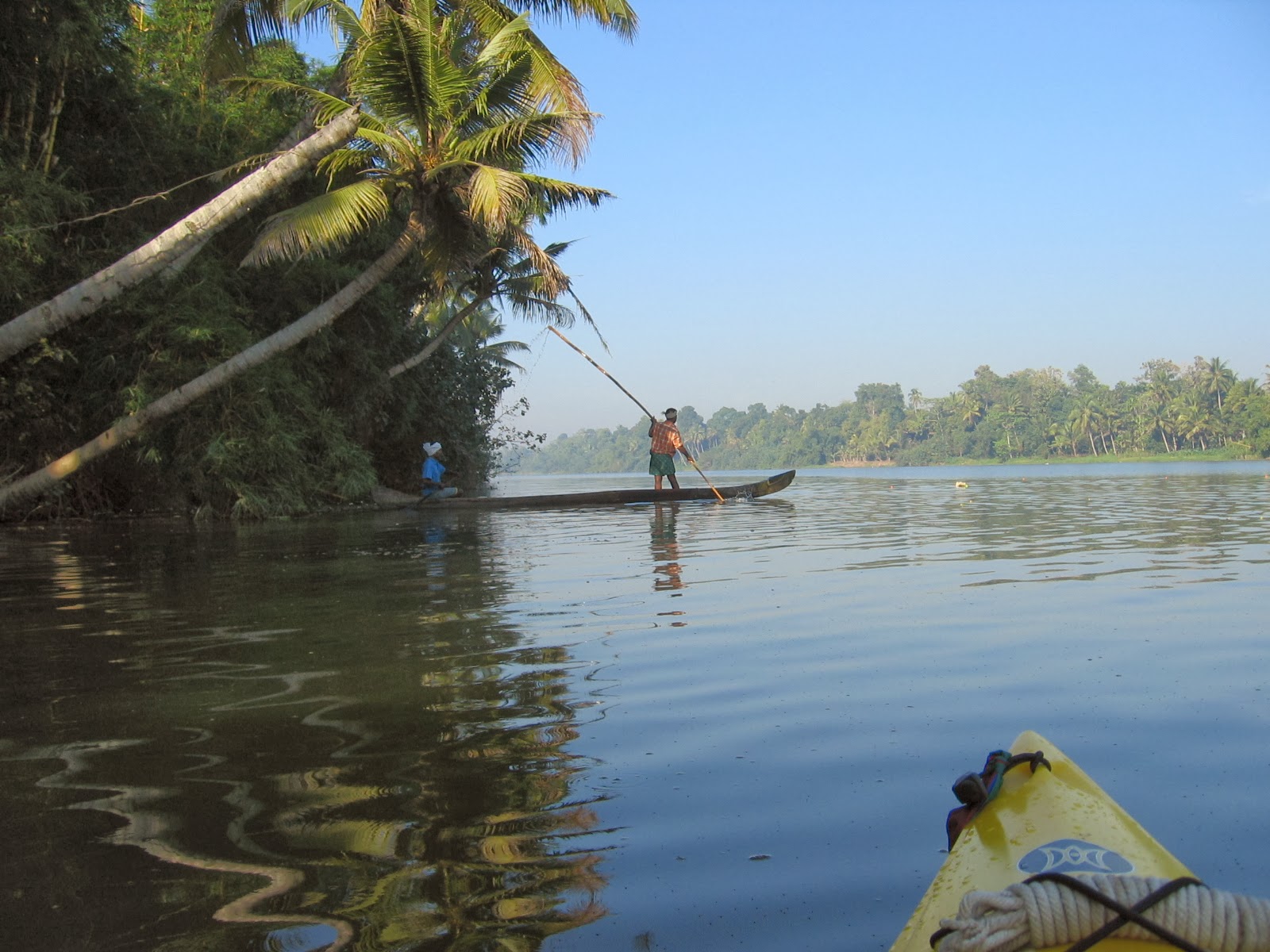
As I paddled, one could feel the depth of river Pampa, her darkness amplified by unchecked sand extraction and the stories Grandfather shared years back of spirits! I prayed to all gods as I paddled with my headlights ON and barely making out the course to follow. You could hear the gill net fisherman in the dark. The sun started peeking somewhere behind the western Ghats, lighting the sky crimson red. December is the so called winter in Kerala and you can admire the evaporation from the river condensing on the surface itself and gently being blown by the breeze; a thousand spirits loomed in front, as I headed to my next destination - Pandanadu(The place believed to be habited by the Pandavas, during their vanvas)!

d
Kadathuvallam - River cossing point along Pampa
I could see my Dad, run into the river from the banks of the Pampa. He shares his fond childhood memories and one among them I vividly remember is how he with his friends would run after their school in Kallisherry, leaving the books on the river bank and then taking the splash in Pampa before heading home. He shared how the sand bars stretched from either bank and how one could walk over them during summer. Thanks to gulf boom and the Malayalees social pressure of "We two, our biiiiiig home" concept, the pressure on land and water is alike. Sand extraction has left the rivers in dire straits.

Slowly, Pandanadu gave way to Mannar(the bell metal heart of Kerala), where a riverside kapikada(local hotel), was the best rendezvos for breakfast. As I paddled on, the river banks were now at the water level, the first clue of being in Kuttanad. It was closing past 10:00 and the sun was getting strong, I decided to pull over at Veeapuram. Unrolled the tent and used it as bed to rest. Had lunch and it was 03:30 when I started again towards Thotapally spillway.

East of Thotapally spillway
Reaching Thotapally spillway  by around 5, I turned left for Kollam and entered Pallana River. The same river where noted Malayalam poet Kumaranashan perished in a boat tragedy, in the year 1924. As I paddled south of the Thotapally bridge, human habitation started dwindling as was the case with daylight. Being December, the days are comparatively short. As I approached people on the river bank for a place to pitch my tent, my heart beat got stronger and stronger; for none would buy into the idea of letting a stranger pitch tent in their property! I was tending towards panic and as I paddled southbound, I could see less of humans. The place looked erie - not a wind or a human soul to break the silence.

Pallana River
I was always mesmerised by tales of travellers in Kerala and how they were always helped by people when asked for refuge. This was the one reason for my confidence of pitching tent and staying overnight. I was somewhat differing in the 21st century to get the same courtesy. Why would I?; I would not like a stranger in my backyard! Times have changed, why blame the people.

Thats when my sight fell on a oars men, paddling some distance away, and I put all my efforts catching up with him. I told him my situation when he advised that I paddle further south to KV Jetty. KV Jetty was a laid back place on the banks of river Pallana, where a Road abruptly ended, cut short on its west by the river. There were 4-5 rice boats what were anchored as though they were cars parked at an angle in a parking lot. I approached few of the locals; asking help to set up my tent in a vacant property. The response was the same as my heart sank.
Not a soul in sight, Pallana River.


Read on as Part2, to be published shortly......


Thursday, 14 November 2013

We have a Facebook page! Follow our FB page for more updates.

You can now follow our Facebook page dedicated for the expedition, at https://www.facebook.com/ExpeditionNW3

You can see frequent updates from the team, connect with the other followers and discuss various topics there. The FB page will see lots of actions during the expedition where we'll be constantly posting updates and photos along our way.

Sunday, 10 November 2013

Kuttanad, the rice bowl of Kerala.

Reaching Thotapalli speelway from Alapuzha


Champakullam Church
The love with Kuttanad started as a kid, visiting my grandparents during summer vacations every year. One of my Aunt was married in Kunnankeri and it was the annual trip there, that got me interested in the waterways. In the absence of AC(Alapuzha Changanacherry road), KSWTC was the only option. We would start from Changanacherry boat jetty at 6 and look forward to the trip, that took more than an hour to reach Kunnenkeri.

Houseboat
Kuttanad is a strip that is below sea level! Flanked by the Arabian sea on one side and the plains at the foothills of the western Ghats, on the other. A narrow stretch of land(breakwater), few kilometers in width, works as the natural barrier from the sea.  This entire strip of land, between the sea and the backwaters has sand that is special; called  pancharamanal(sugar sand), in Malayalam. The backwaters that form kuttanad had natural tidal movement, until the Thanneermukkom bund was build north of Chertala, with help of  Dutch aid, in 1977.  Saltwater used to flow inward from the north(opening close to the Cochin harbour) and cover the entire flood plain during summer, in addition to the openings from Kayankulam canal and Thotapally. To support cultivation in kuttanad and to overcome the food famine, post-independence, the bund was built to stop the tidal movement during summer, giving farmers the ability to cultivate twice a year; Earning the title "the rice bowl of Kerala". Today, acreage in Kuttanad has come down drastically as fields are less viable and  conversion for non-agrarian use. The lack of tidal motion has resulted in accumulation of  pollutants aided by thousands of house boats that crisscross them, dumping waste and fouling the water with their engine exhaust. All this has resulted in renewed thinking among a cross-section of people, about the Thaneermukkom bund!

One cannot think about Kuttanad without refering to the concept of backwater paddy cultivation that was pioneered by Shri Murriken, who was the visionary in backwater reclamation and farming. His legacy lives on in the form of the Rani, Chitra and R -Block Kayals, many of which are in ruins. For more details, please refer wikipedia.


Coconut palm
As I kayak today on the backwaters, I am really concerned for the eco-system. Lack of tidal motion during summer results in a lot of stagnant waters in small canals. Compounding the degradation is the un-restricted construction of roads and bridges ; further restricting the flow, waste getting dumped; for want of proper awareness and infrastructure. There was a time, when you went from Muhama to Kumarakom on the KSWTC(Kerala Water Transport Corporation) boats, a section of the journey would be in water that was bottom visible clear. Today, this remains fond memory of a by gone era. Dredging for limestone on an industrial scale also contributed to the dip in water quality,  south of Thaneermukkam bund.

The unspoilt section that I have seen is in and around Pallana river, running parallel from Thotapally speelway to Kayankulam kayal, where the water is still clean. Thanks to the tsunami of 2004, toursim is yet to strangulate this section. In some places you can see the floor; and at night when you shine the torch, you will be amazed by the rubies! Yes;the beautiful eyes of lobsters that shine back at you! Here, the venice of the east is at her best. One hopes these ecosystems are conserved for future generatioin.


Anees joins Expedition NW3! Super excited!

Hi Everyone! This is Anees writing from Bangalore who has joined Vipin Ravindranath on his NW3 Expedition!

It was from a Facebook status update of Vipin Ravindranath, I came to know about his plans to paddle on the National Waterway 3 on his Kayak. He was looking for a partner to join this expedition and I didn't have to think twice before I decided to join him on his expedition. Being a passionate adventurous traveler, I have done many treks, but I knew that this was going to be something completely different. We discussed about the challenges involved and then decided to take it up forward.

Many things have happened in the last few weeks. We have been doing the ground works for the expedition. The logo has been released. The flyer is out. We are now in the run for finding sponsors who could support us in this mission and also in the process of getting permissions and supports from various state departments.

I am super excited about this expedition for two reasons. I have always been an admirer of the backwaters in Kerala and this is an opportunity for me to explore the entire stretch of the backwaters, that too by paddling on the entire stretch; sounds too exciting! I am going to be part of a mission to salute the rice boatmen who have plied on these waters for time immemorial and also get to inculcate environmental sensitivity and spread the message to save the natural resources.

You'll soon get to see the expedition logo and the flyer. Keep watching this space for more updates.

Cheers,
Anees